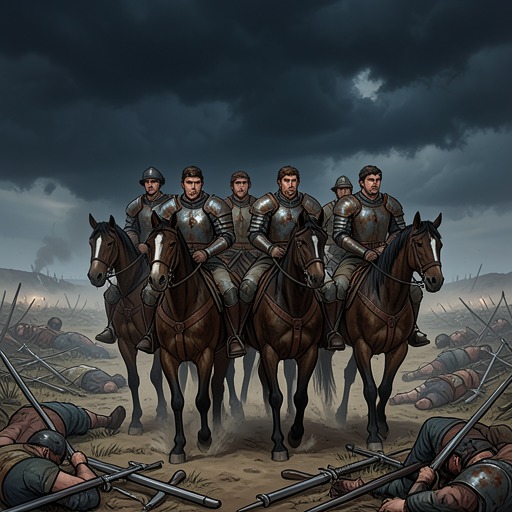
Rainbow Guard
A Clash of KingsThe Rainbow Guard is Renly Baratheon’s alternative to the traditional Kingsguard, created during his bid for the Iron Throne. Its distinctive colors, ceremonial splendor, and carefully chosen knights turn royal protection into a public declaration of Renly’s identity as a king: not merely lawful authority in armor, but a brilliant, youthful, self-conscious spectacle of power.
Formation and Structure
Renly Baratheon created the Rainbow Guard as his own Kingsguard, but rejected the established requirement that its members wear white. Each of the seven knights instead wore a different color, making the order visually unlike the Kingsguard and allowing its members to be recognized as part of Renly’s separate court. Loras Tyrell, the Knight of Flowers, served as Lord Commander.
The organization’s structure therefore preserved the number and protective function associated with a royal guard while altering its outward language. The seven colors announced that Renly was not simply claiming an existing office; he was presenting a new version of kingship, with ceremony and appearance made central to political legitimacy. Its pageantry suited Renly’s taste for bright colors, rich fabrics, and theatrical display, qualities remembered from his childhood at Storm’s End and still visible in his adult political persona.
Membership and Oaths
Brienne of Tarth entered the Rainbow Guard through victory rather than inheritance or courtly favor. At the great melee at Bitterbridge, Renly declared her the victor and noted that she had been the last mounted knight among one hundred sixteen competitors. When he offered her any boon within his power, she asked for a place among the seven, pledging her life to Renly, promising to go where he went, ride at his side, and keep him safe from harm. Renly accepted her request.
Brienne’s admission reveals that the Rainbow Guard was not only an ornamental institution. Its members were expected to bind themselves personally to Renly and to protect him wherever he traveled. Her request also gives the order an unusual emotional and social dimension: she sought service to the king she revered, and the public exchange transformed her martial achievement into a formal relationship of personal loyalty.
A later listing identifies several of the order’s members: Loras Tyrell as Lord Commander, Lord Bryce Caron as the Orange, Ser Guyard Morrigen as the Green, and Lord Steffon Varner. The surviving references do not provide a complete account of every member or assign every color, but they establish the guard as a defined seven-knight institution rather than a loose group of household retainers.
Political Meaning
The Rainbow Guard helped Renly distinguish his claim from those of rival rulers. Its colors and new raiment proclaimed a competing royal order at a moment when the realm was divided among claimants. The institution translated political rebellion into visible ceremony: a king required a guard, but Renly’s guard also had to look like Renly’s kingdom.
That theatrical quality is presented with affection and unease. Renly’s love of spectacle had existed since boyhood, when he delighted in pretending to be a dragon, a wizard, or a rain god. As a grown man he continued to play at identities, and the Rainbow Guard becomes the courtly form of that play. The image of a young prince shouting for others to look at him is echoed by the adult king’s colored knights, whose uniforms make his claim impossible to overlook.
The order also exposes the unstable boundary between political substance and performance. Its members are real warriors, and Brienne’s pledge is a serious commitment, yet the guard’s visual novelty makes royal authority appear as something staged and displayed. Renly’s kingship depends not only on armies and alliances but on the ability to create a compelling image of sovereignty.
Contrast with Other Orders
The Rainbow Guard’s most important institutional contrast is with the Kingsguard. The Kingsguard is associated with white cloaks, inherited vows, and the established symbolism of royal service; Renly’s order keeps the seven-knight pattern but replaces uniform whiteness with individual colors. The difference is therefore both practical and ideological. Renly borrows the authority of a familiar royal institution while altering its appearance to mark his independence.
This contrast also illuminates the broader problem of vows and political allegiance. Jaime Lannister later describes the conflicting obligations imposed on a knight: defending and obeying the king, keeping secrets, protecting the innocent, defending the weak, respecting the gods, and obeying family. Against that background, the Rainbow Guard’s pledge to Renly appears as a concentrated form of personal service. Its members do not merely belong to an abstract office; they promise to follow Renly, stand beside him, and protect his body.
The order’s vivid colors consequently carry a double meaning. They signify Renly’s imaginative, celebratory style of rule, but they also mark a direct challenge to older institutions whose symbols claim continuity and legitimacy. The Rainbow Guard is new because Renly wants his kingship to be seen as new.
Narrative Significance
The Rainbow Guard condenses Renly Baratheon’s political character into an institution. It is disciplined enough to be a royal guard, aristocratic enough to gather prominent knights, and theatrical enough to resemble a costume of kingship. Its seven colored members make personal loyalty public, turning protection, spectacle, and political allegiance into the same visible performance.
Brienne’s entrance into the order provides its clearest expression of purpose: a victorious knight chooses not wealth or land but the honor of serving at Renly’s side. Yet the order’s brilliance also carries an implicit fragility. By replacing the established white cloak with a pageant of colors, Renly creates a symbol perfectly suited to his charisma and vulnerable to the collapse of the personal kingship it represents. The Rainbow Guard thus stands as both a genuine protective brotherhood and a vivid emblem of Renly’s attempt to make a rival monarchy through style, ceremony, and devotion.